Material choice determines how glossy, durable, and stable your inflatable mirror balls will be—especially under real-world handling and outdoor light. Most professional builds use a multilayer “mirror film on reinforced base” approach, with thickness and UV package tuned to use-case. If you also need brand colors or custom sizes, see customize inflatable mirror balls.
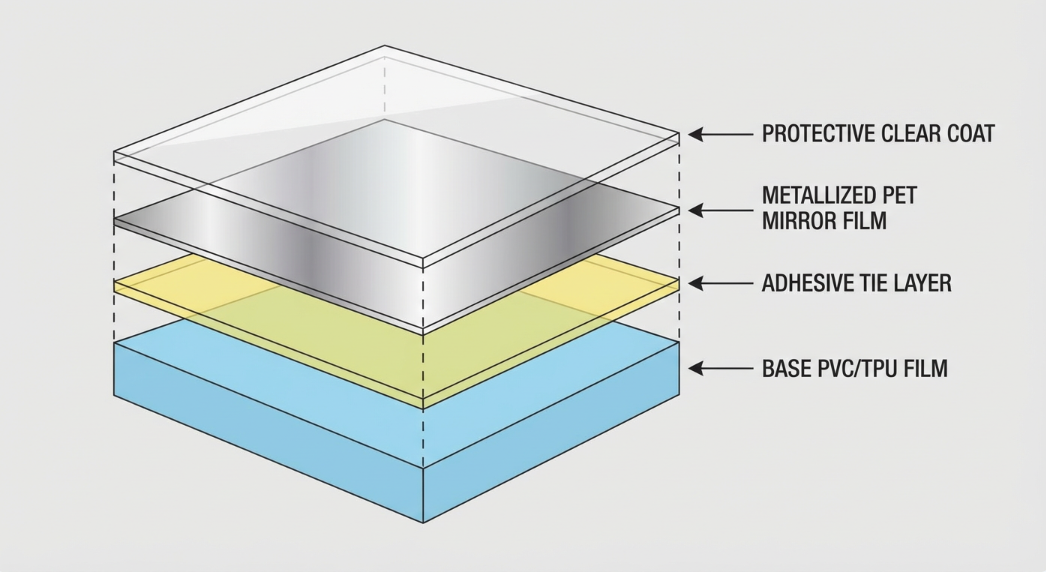
For mirror-like gloss with real-world durability, a proven stack looks like this:
Why this works:
Recommended baselines by size/use:
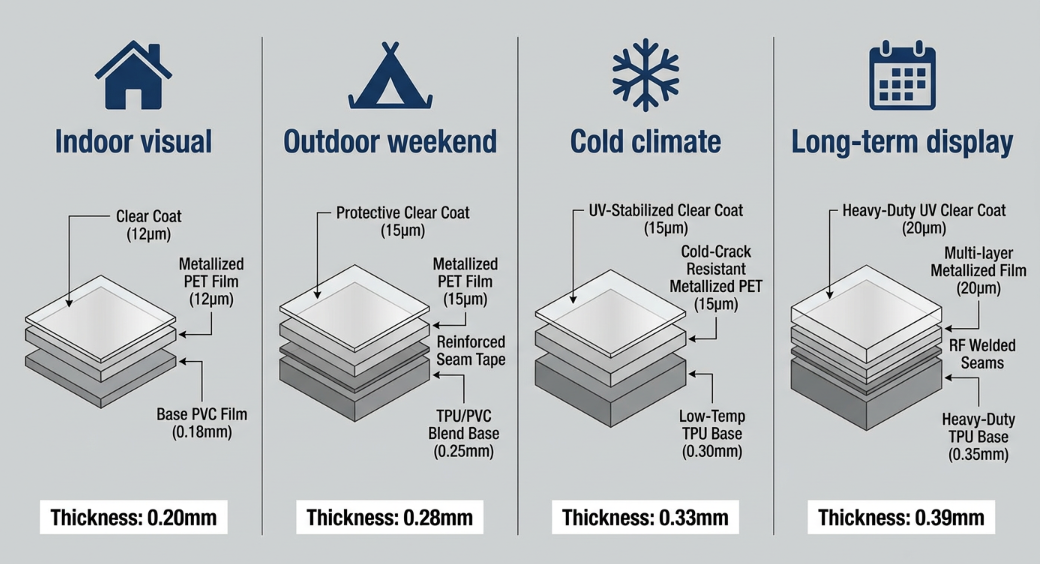
Yes—specify to the supplier by use-case. A practical mapping:
| Scenario | Recommended Spec | Notes |
|---|---|---|
| Indoor visual displays | PVC 0.4–0.6 mm + metallized PET + clear coat | Highest gloss/clarity at best cost |
| Outdoor weekend events | PVC/TPU 0.6–0.8 mm + UV stabilizers + clear coat | Add reinforced D‑rings and seam patches |
| Cold climate (sub‑zero) | TPU 0.6–0.8 mm + UV package | TPU keeps flexibility in cold; check weld parameters[6] |
| Long-term outdoor install | UV‑stabilized PVC/TPU 0.7–0.9 mm + premium clear coat | Request ISO 4892/ASTM D4329 weathering summary[4] |
| Heavy handling/rigging | Thicker base + wider RF seam + hardware plates | Reduces seam creep/tearing under load[5] |
On your PO, include: base film type and thickness (ASTM D6988), mirror layer type (metallized PET), clear coat, UV test basis (ISO 4892/ASTM D4329), and seam method with reinforcement photos[3][4][5][9].
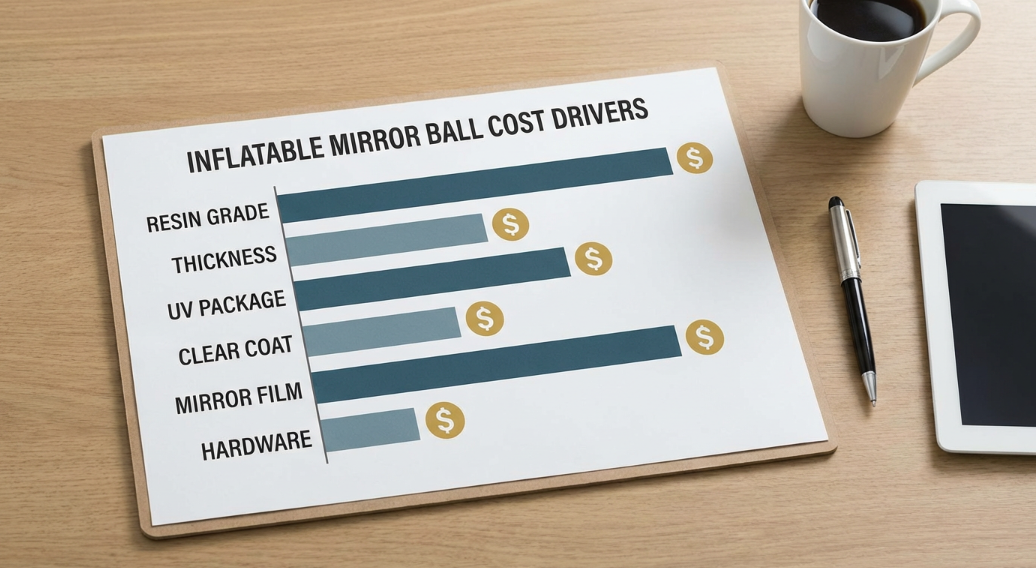
Yes. Typical cost drivers and how they scale:
How to control budget without killing shine:
Most mass‑market products use PVC base film (about 0.5–0.8 mm) with a laminated metallized PET mirror layer and a protective clear coat, assembled by RF/heat welding[5][7][8]. This balances:
Higher‑end or cold‑weather builds swap the base to TPU while keeping the same mirror/clear‑coat stack, adjusting weld settings accordingly[5][6].
For the best “mirror look” that survives real use, pair a quality mirror layer (metallized PET) and clear coat with a base film matched to your environment: PVC for cost‑effective indoor/general use, TPU for cold or high‑flex cases. Lock the thickness, UV package, and seam reinforcement in your PO, and ask for simple weathering and QC data to avoid surprises. Need a tailored spec for your event or venue? See customize inflatable mirror balls.
Title:
Best Materials for Inflatable Mirror Balls: Buyer’s Guide for Imports from China
Description:
See the optimal material stack for inflatable mirror balls—PVC vs TPU bases, metallized PET mirror layers, UV packages, and clear coats—plus cost and use‑case tips.
Keywords:
inflatable mirror ball materials, PVC vs TPU, metallized PET mirror film, RF welding seams, UV weathering ISO 4892, ASTM D1003 haze, high gloss clear coat
[1] ASTM D1003 — Haze and Luminous Transmittance of Transparent Plastics
https://www.astm.org/d1003
[2] ASTM D523 — Specular Gloss
https://www.astm.org/d0523
[3] ASTM D882 — Tensile Properties of Thin Plastic Sheeting
https://www.astm.org/d0882
[4] ISO 4892-2 — Plastics: Laboratory Light Exposure (Xenon‑Arc)
https://www.iso.org/standard/77365.html
[5] Miller Weldmaster — RF/Heat Sealing of PVC/TPU for Industrial Fabrics
https://www.millerweldmaster.com/blog/rf-heat-sealing
[6] Lubrizol Estane TPU — Outdoor/Weatherability and Film Applications
https://www.lubrizol.com/Engineered-Polymers
[7] DuPont Teijin Films — Melinex/Lumirror Metallized PET (Overview)
https://www.dupontteijinfilms.com/products/metallized-films/
[8] Teknor Apex — Weatherable PVC Compounds (Outdoor Vinyl)
https://www.teknorapex.com/vinyl
[9] ASTM D6988 — Guide for Determination of Thickness of Plastic Film
https://www.astm.org/d6988


![What Is an Air Track in Gymnastics? [Complete Guide]](http://ueeshop.ly200-cdn.com/u_file/UPBF/UPBF509/2605/13/photo/WhatIsanAirTrackinGymnastics.png)


