When importing inflatable gymnastics mats from China, you must request highly detailed specifications to ensure durability and safety. Key specifications to mandate include the PVC thickness (typically 0.9mm to 1.2mm), yarn denier (1000D or higher), Double Wall Fabric (DWF) drop-stitch density, and the specific type of air valves (e.g., Bravo valves). To avoid misunderstandings, B2B buyers should never rely on verbal agreements; instead, hardcode all technical metrics, dimensional tolerances, and required compliance standards (like REACH or CE) directly into the Proforma Invoice (PI) and Purchase Order (PO).
Table of Contents
- What Specifications Should I Request for Inflatable Mats?
- How Do I Interpret Technical Specifications for These Mats?
- Are There Industry Standards for Inflatable Gymnastics Mats?
- How Can I Ensure the Supplier Provides Accurate Specifications?
- Interactive Quiz: Test Your Specification Knowledge
- Conclusion
- References
1. What Specifications Should I Request for Inflatable Mats?
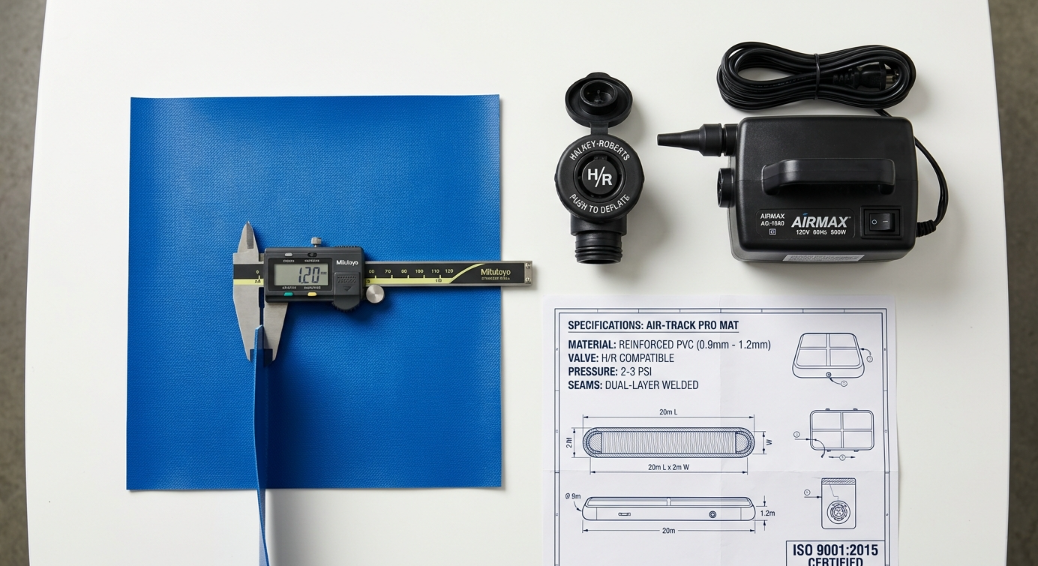
When communicating with a Chinese manufacturer, vague requests like "high quality" or "bouncy" will result in inconsistent products. You must specify the exact physical and chemical properties of the mat.
Here is a checklist of the core specifications you should always request:
- Dimensions & Tolerances: Exact Length, Width, and Thickness (typically 10cm, 15cm, 20cm, or 30cm). Include an acceptable tolerance margin (e.g., ± 1cm).
- Material Grade: Specify 1000D (Denier) PVC or higher. Specify the PVC thickness for both the sides and the top/bottom (e.g., 0.9mm on top/bottom, 1.2mm reinforced sides).
- Core Construction: Request the details of the Double Wall Fabric (DWF). You need to know the density of the drop-stitch threads.
- Seam Construction: Specify "Heat-Welded Seams" rather than cold-glued seams, as heat welding offers vastly superior longevity and airtightness.
- Hardware: Specify the exact valve brand or style (e.g., "Authentic Bravo Air Valves").
- Accessories: Specify the voltage and wattage of the electric pump (e.g., 110V US plug or 220V EU plug, 500W-600W), and outline the exact contents of the repair kit.
2. How Do I Interpret Technical Specifications for These Mats?
Factory specification sheets can sometimes look like a jumble of letters and numbers. Here is a quick guide to decoding the most important B2B technical jargon:
| Specification Term |
What It Means |
Why It Matters for B2B Sourcing |
| DWF (Drop-Stitch) |
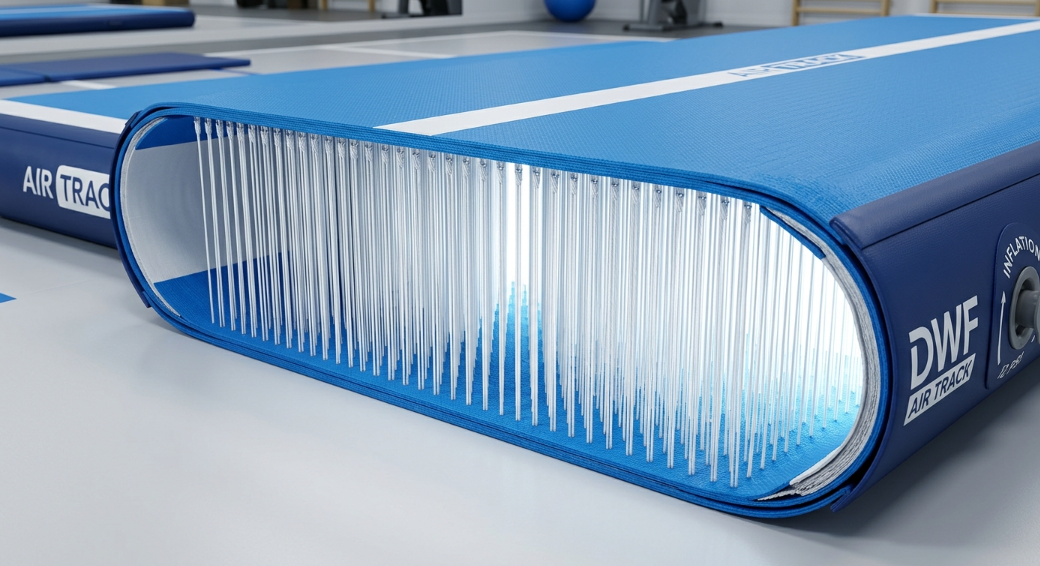
Thousands of internal polyester threads connecting the top and bottom PVC layers. |
This is what allows the mat to be completely flat rather than bulging like a balloon. Higher thread density equals a firmer, more durable mat. |
| Denier (e.g.,1000D) |
A unit of measurement for the linear mass density of fibers. |
Measures the thickness of the base fabric. 1000D is commercial-grade. Anything lower (like 500D) is prone to punctures and is only suitable for cheap consumer toys. |
| 0.9mm / 1.2mm PVC |
The thickness of the PVC coating applied over the base fabric. |
0.9mm is the industry standard for the top jumping surface (balancing durability with flexibility), while 1.2mm is often used to reinforce the side rails where seams meet. |
| PSI / Bar |
Pounds per Square Inch / Metric pressure measurement. |
Indicates the maximum safe inflation pressure. Commercial mats should comfortably hold between 1.5 to 3.0 PSI depending on thickness and desired bounce. |
3. Are There Industry Standards for Inflatable Gymnastics Mats?
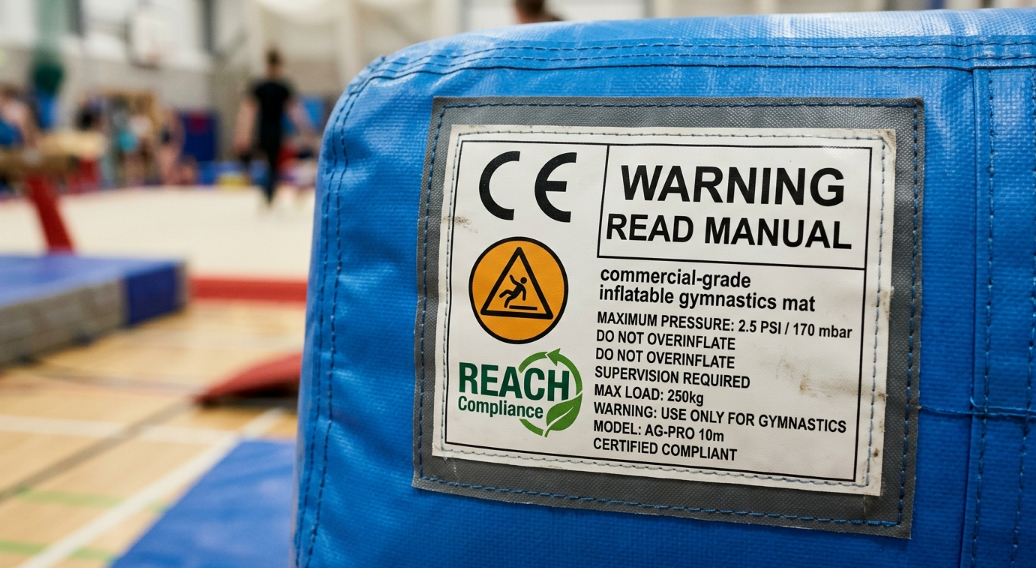
Yes, depending on where you are selling your imported mats, there are strict legal and industry standards you must adhere to. Do not assume Chinese manufacturers meet these by default; you must specify them.
- REACH Compliance (Europe): Ensures the PVC material is free from harmful levels of Phthalates and heavy metals. This is critical if children will be using the mats.
- CPSIA (United States): The Consumer Product Safety Improvement Act requires strict limits on lead and phthalates for any products intended for children under 12.
- CE Certification: While the mat itself usually doesn't require CE certification, the electric air pump absolutely must have a verifiable CE mark for the European market, or UL/ETL certification for the US market.
- ISO 71618: This is the international standard covering the safety and testing methods for gymnastics equipment, including trampolines and inflatable tracks.4
4. How Can I Ensure the Supplier Provides Accurate Specifications?
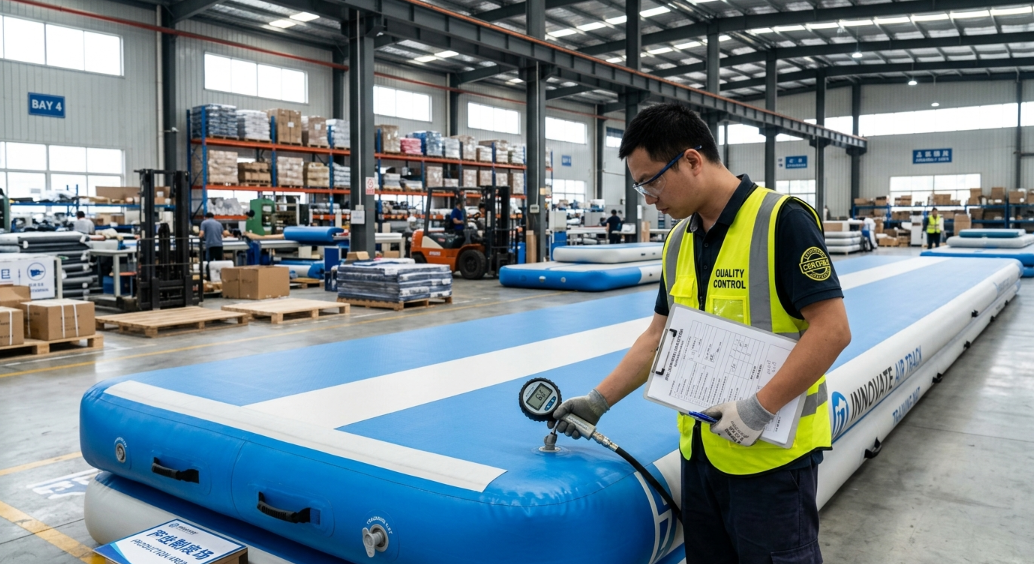
The biggest risk in overseas sourcing is "spec-fading"—where a factory sends a high-quality sample but slowly degrades the material quality in bulk production to save costs. Protect your investment with these three steps:
- The "Golden Sample" Rule: Order a physical sample. Once approved, both you and the factory sign off on it. This becomes the "Golden Sample" against which all mass production is measured.
- Hardcode the Proforma Invoice (PI): Never rely on WeChat or email promises. Every technical detail (1000D, 0.9mm PVC, REACH compliance) must be written explicitly into the final PI and manufacturing contract.
- Pre-Shipment Inspection (PSI): Hire a third-party inspection agency (like SGS or QIMA) to visit the factory in China before the container is loaded. They will measure the thickness, weigh the products, and test the air retention to guarantee the specifications match your contract.
5. Interactive Quiz: Test Your Specification Knowledge
1. When reviewing a supplier's quote, what does "1000D" refer to?
- A) The maximum weight limit of the mat in pounds.
- B) The linear mass density and thickness of the base fabric fibers.
- C) The specific type of heat-welding machine used.
2. If you are importing Air Tracks to Europe, what certification is absolutely mandatory for the included electric air pump?
- A) CPSIA
- B) ISO 71618
- C) CE Certification
*(Answers: 1-B, 2-C. Mastering these specifications is your first line of defense against poor-quality imports!)*
6. Conclusion
Navigating the technical specifications of inflatable gymnastics mats is the key to differentiating your brand from low-quality, generic sellers. By mastering the terminology—from DWF density to Denier ratings—and demanding rigorous compliance standards, you protect your customers and your profit margins.
If you need a reliable manufacturing partner who is fully transparent about materials and specifications, contact us. Our team can provide complete datasheets and test reports to ensure your next shipment of Air Tracks meets exact commercial standards.
7. References
- REACH Enforcement — Understanding European chemical compliance for PVC and plastics.
- CPSIA Requirements — US standards for lead and phthalate limits in children's products.
- CE Marking Guidelines — Official EU requirements for electronic accessories like air pumps.
- ISO Standard 71618 — International safety and testing standards for gymnastics equipment.


![What Is an Air Track in Gymnastics? [Complete Guide]](http://ueeshop.ly200-cdn.com/u_file/UPBF/UPBF509/2605/13/photo/WhatIsanAirTrackinGymnastics.png)


