
There was a time when practicing flips, handsprings, and vaults meant dealing with heavy, awkward foam blocks. If you wanted to practice at home, you had to settle for thin panel mats that offered barely any cushion for your joints. If you ran a professional gym, you had to spend thousands of dollars on permanent, massive spring floors that took up an entire room.
Thankfully, the fitness world has changed. The introduction of air-filled training equipment has completely transformed how athletes train. Today, an inflatable tumbling mat offers a portable, highly bouncy, and protective surface that can be set up in a backyard, a living room, or a professional training facility within minutes.
But as the popularity of this gear has exploded, the market has become crowded with countless options. Walk into any digital marketplace and you will see hundreds of products that look exactly the same on the surface. They use the same bright colors, list similar dimensions, and all claim to be the safest option available.
However, beneath that colorful exterior lies a massive gap in manufacturing quality. Choosing the wrong equipment can lead to structural failures, dangerous mid-training deflations, and joint pain. This comprehensive inflatable gym mat buying guide is designed to take the guesswork out of your search. We will look at the critical details you need to evaluate—from internal raw fabrics to safety hazards—so you can confidently choose the best inflatable gymnastics mat for your space and training goals.
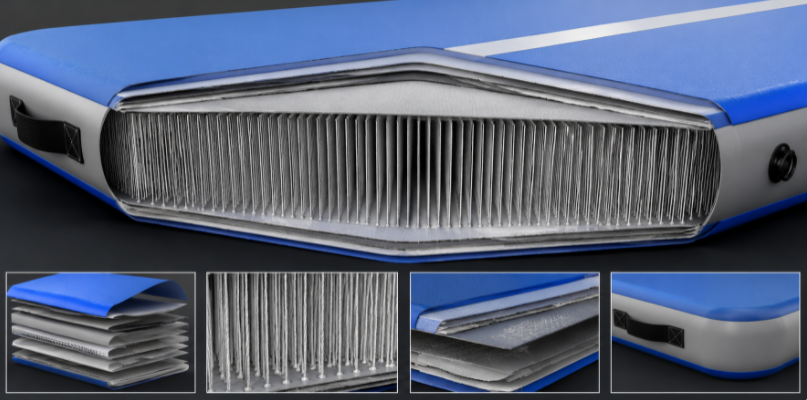
When you look at a high-quality air track tumbling mat, you are not looking at a glorified pool float. A pool float is essentially a hollow balloon made of thin plastic; when you step on it, the air simply pushes out to the sides, causing the surface to sink and sag. A premium training mat, however, acts like a rock-solid trampoline surface when fully inflated.
This rigid stability is entirely due to an advanced internal engineering breakthrough known as Double-Wall Fabric (DWF) powered by Drop-Stitch technology.
Inside the core of a premium gymnastics air track mat, there are tens of thousands of tiny, incredibly strong polyester threads connecting the top piece of material to the bottom piece.
The internal core is only half of the equation. The exterior must be wrapped in a rugged, military-grade defensive layer. The gold standard for this outer shell is a multi-layered, commercial-grade PVC (Polyvinyl Chloride) material.
To know exactly what to look for when inspecting these industrial textiles, it helps to understand the specialized air track materials that prevent micro-leaks, withstand rough concrete or grass surfaces, and resist peeling under direct sunlight. The best manufacturers use a thick PVC material that features an internal fiber scrim mesh for anti-tear reinforcement. Furthermore, ensure the material is treated with a UV-resistant coating so it will not become brittle or crack when you take your training sessions outdoors on warm, sunny days.
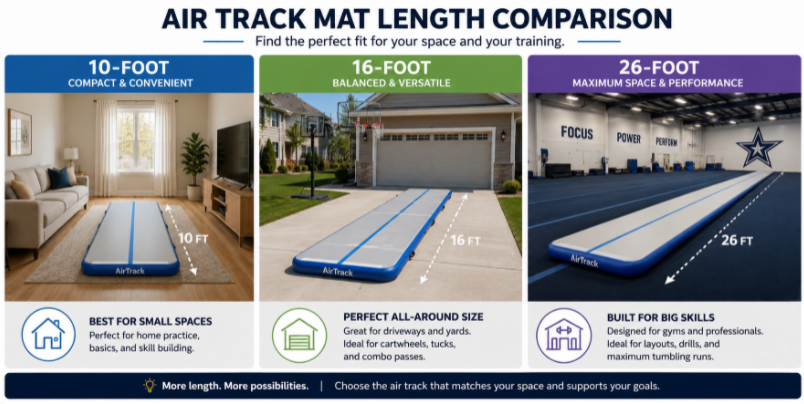
Selecting the physical length and width of your mat requires balancing two competing priorities: your available floor space and the specific athletic movements you intend to practice. If you buy a mat that is too short, you will run out of room mid-routine and risk stepping off onto hard ground. If you buy a mat that is too long, you will find yourself struggling to fit it inside your home or backyard.
To make this decision easier, refer to a comprehensive mat size guide that outlines universal dimensions, helping you understand how standard 3-meter (approximately 10-foot) options compare to massive 20-foot professional tracks.
To find your perfect fit, categorize your training goals into one of three common length brackets:
| Mat Length | Ideal User Profile | Best Suited Movements | Recommended Space |
|---|---|---|---|
| 10 to 13 Feet (3 to 4 Meters) | Toddlers, young children, martial artists, and stationary fitness users. | Standing backflips, handstands, cartwheels, stretching, and basic martial arts kicks. | Small apartments, bedrooms, living rooms, and compact patios. |
| 16 to 20 Feet (5 to 6 Meters) | Developing athletes, cheerleaders, and intermediate gymnasts. | Multi-step routines, such as a round-off followed by a back handspring. | Large backyards, driveways, garages, and local park lawns. |
| 26+ Feet (8+ Meters) | Elite tumbling athletes, competitive cheer squads, and commercial gyms. | Advanced, high-speed tumbling passes involving multiple consecutive flips and twists. | Professional training centers, dance studios, and expansive outdoor fields. |
While length determines the number of skills you can string together, width determines your safety margin. The standard width for a residential track is 3.3 feet (1 meter). This provides plenty of space for single-line tumbling passes.
However, if you are purchasing equipment for a commercial gym, cheer school, or specialized tricking program, upgrading to a 6.6-foot (2-meter) wide track is highly recommended. The added width provides a crucial safety net, ensuring that if an athlete accidentally veers off-course during a high-speed spin, they will still land safely on an air cushion rather than crashing onto the hard floor.
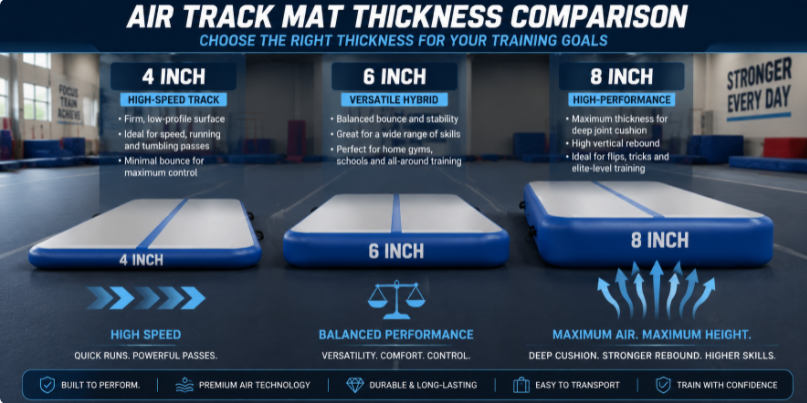
If material quality determines how long your mat lasts, thickness determines how your joints feel the morning after a grueling four-hour training session. The thickness of an air track changes its fundamental behavior, alterable by shifting the air pressure inside.
The market generally offers three primary thickness levels. Choosing the correct one depends entirely on the body weight, skill level, and safety needs of the person using it.
| 4-INCH (10 CM) THICKNESS | 6-INCH (15 CM) THICKNESS | 8-INCH (20 CM) THICKNESS |
| High pressure, firm feel. | The versatile hybrid. | Deep cushion, max launch. |
| Ideal for lightweight users and quick spring. | Balances high rebound with deep joint cushion. | Perfect for heavy impact, advanced flips, & seniors. |
This is the most common thickness for entry-level residential mats. Because it sits lower to the ground, it requires higher internal air pressure to prevent heavier users from "bottoming out" (hitting the solid floor below during a hard landing).
For the vast majority of households and commercial programs, a 6-inch thickness is the absolute ideal choice. It offers a larger volume of air, meaning you can adjust the firmness across a much wider spectrum.
This is the heavy-duty tier of the training world. An 8-inch thick mat holds a substantial volume of air, acting like a hybrid between a high-end spring floor and a professional stunt airbag.
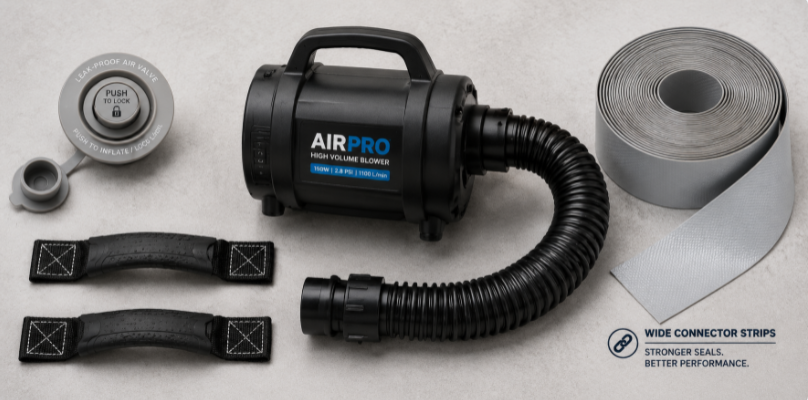
When you purchase a tumbling track, your user experience is shaped by the accessories bundled inside the delivery box. A great mat accompanied by poor-quality tools quickly turns setting up your equipment into a frustrating chore.
You cannot use a standard bicycle tire pump to fill an air track; the connection valves are entirely incompatible. Instead, you must use either a specialized manual high-pressure hand pump or an electric high-volume blower.
Before making a purchase, take a close look at the different pump options available on the market today. While some modern mats feature built-in inflation systems, a standalone commercial electric pump is generally considered the most reliable option. A high-quality electric pump should look like a miniature vacuum cleaner, packing at least 600 to 800 watts of power. It should be able to fully inflate a standard 15-foot mat in under 60 seconds and, just as importantly, completely deflate the track down to a vacuum-sealed flat sheet for easy storage.
Don't just look at the pump. Check the product listing for these three essential accessory components:
1. BRAVO Inflation Valves: The valve is the gatekeeper of your air pressure. Look for mats that feature authentic Bravo brand valves or high-grade nylon leak-proof systems. These feature a secure push-button pin mechanism that locks closed, ensuring that when you remove the pump hose, zero air escapes.
2. Commercial-Grade Velcro Strips: If you think you might want to expand your training floor in the future, check to see if the mat has built-in Velcro strips on the short edges. This allows you to use a smart accessory called an "Air Track Connector" to securely link two mats together in a straight line without creating a dangerous gap in between.
3. Heavy-Duty Dual-Stitched Handles: A 15-foot or 20-foot mat can be heavy and awkward to carry when fully inflated. Ensure the track features thick nylon handles that are reinforced with double-stitching and covered in comfortable molded rubber grips.
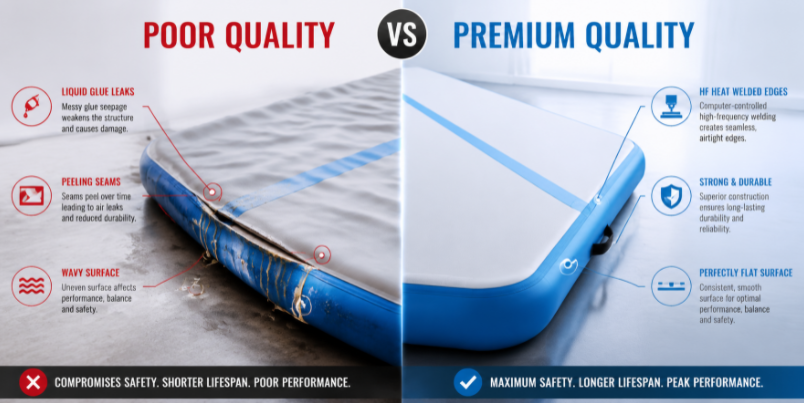
It is a basic rule of economics: when a product becomes popular, cut-rate manufacturers flood the market with cheap imitations. Buying a cut-rate, poorly manufactured mat isn't just a waste of money—it presents a genuine physical safety risk to anyone flipping on it.
To keep your training safe, protect your investment, and avoid buyers' remorse, keep a sharp eye out for these three major manufacturing red flags.
This is the hidden flaw you cannot easily see in online pictures. Cheap factories assemble their mats by hand using basic liquid industrial glue to hold the PVC panels together. Over time, the internal air pressure combined with hot summer weather degrades this glue. The seams will begin to blister, bubble, and slowly leak air.
Elite manufacturers use computer-controlled high-frequency thermal heat-welding. This process melts the overlapping layers of PVC together into a single, unified sheet. A heat-welded seam is structurally unbreakable and will never leak, crack, or pull apart over time.
When you open a brand-new inflatable product, a faint plastic smell is completely normal. However, if you open the box and are immediately hit by a powerful, eye-watering chemical stench that fills the entire room, this is a major warning sign.
This toxic smell indicates that the factory used cheap, unrefined recycled plastics and low-grade chemical adhesives packed with banned phthalates or toxic volatile organic compounds (VOCs). High-end training gear is built using non-toxic, eco-friendly, and skin-safe virgin PVC materials that are completely odorless and safe for young children to touch.
If every reputable brand is selling a 15-foot mat for around $300, and you stumble across an online listing offering the exact same size for $85, be highly suspicious.
To hit that low price point, the factory has to cut every corner possible. They will use thin, single-layer PVC that punctures easily on a stray twig, reduce the density of the internal drop-stitch threads (causing the mat to bow and distort), and omit crucial quality control testing phases. Reading a dedicated guide on why cheap air tracks fail can save you from making a costly mistake, illustrating how low-tier products lose pressure mid-use and compromise an athlete's ankles and wrists.
Investing in a premium inflatable tumbling mat is one of the most rewarding decisions you can make for your training progression, gym business, or child’s athletic journey. It replaces fear with confidence, providing a forgiving, protective, and energetic surface that encourages athletes to push their boundaries and master new skills safely.
By focusing heavily on high-frequency heat-welded seams, choosing a thickness that matches your joint safety needs, and selecting a length that fits your training space, you elevate your practice sessions. Avoid the trap of cut-rate imitations, invest in long-term structural durability, and enjoy the peace of mind that comes with knowing your training floor is built to handle every jump, twist, and landing safely.
A: Yes, absolutely. These tracks are designed to be highly versatile. However, you must inspect the setup area carefully before rolling out the mat. Clear away any sharp rocks, twigs, roots, or glass shards if you are setting up on grass. If you are placing the mat down on rough concrete, a gravel driveway, or brick pavers, it is highly recommended to lay down a protective tarp or foam puzzle tiles underneath to prevent continuous friction from wearing down the bottom PVC layer.
A: The perfect pressure depends entirely on the user's weight and personal preference, but a general rule of thumb is the "hand-press test." When the mat is fully inflated, you should not be able to press your thumb down into the center surface by more than half an inch. If you stand on the track and your heels sink through to touch the hard floor underneath, the pressure is too low. For advanced athletes who want maximum spring, pump the mat up until it feels as solid and rigid as a traditional wooden deck.
A: Maintenance is simple. After a sweaty training session, wipe down the surface with a soft microfiber cloth dipped in warm water mixed with a small amount of mild, antibacterial dish soap. Never use harsh chemical solvents, bleach, or abrasive scrubbing pads, as these will erode the protective UV coating on the PVC. Ensure the mat is 100% dry before deflating and rolling it up; storing a wet mat traps moisture inside the folds, leading to mold and mildew growth that can destroy the fabric.
A: A premium mat assembled with heat-welded seams and secure Bravo valves should easily hold its air pressure for several days without needing a top-off. It is completely normal for a mat left outside overnight to feel slightly softer in the morning. This is not caused by a leak; it is basic physics. Cooler nighttime temperatures cause the air molecules inside the mat to contract. Once the warm afternoon sun hits the mat, the air expands again, and the track will return to its original firmness.
A: Not at all, provided you use your electric pump correctly. To store the mat smoothly, switch your electric pump's hose connection over to the "deflate" port. Connect it to the mat's valve and turn it on. The pump will actively suck every single molecule of air out of the core, turning the massive mat into a flat, limp piece of fabric. From there, fold the sides inward slightly and roll it up tightly from one end to the other, just like a sleeping bag, then slide it into its transport storage bag.


![What Is an Air Track in Gymnastics? [Complete Guide]](http://ueeshop.ly200-cdn.com/u_file/UPBF/UPBF509/2605/13/photo/WhatIsanAirTrackinGymnastics.png)


