What is the standard thickness tolerance for inflatable wrestling mats?
When manufacturing inflatable wrestling mats using Double Wall Fabric (DWF), thickness tolerance refers to the acceptable millimeter deviation from the stated target thickness (e.g., 10cm, 15cm, or 20cm). In professional-grade B2B manufacturing, the acceptable thickness tolerance is strictly ±5mm (0.5cm) across the fully inflated surface. Variations larger than this indicate internal thread snapping, poor tensioning, or inferior DWF material, which compromises the mat's shock absorption and athlete safety. Strict quality control and pre-shipment inspections are required to ensure uniform thickness.
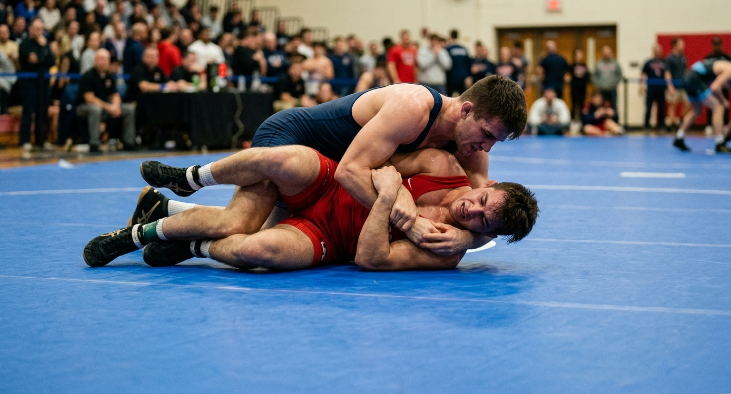
In combat sports like wrestling, Brazilian Jiu-Jitsu (BJJ), and MMA, the floor is an athlete's most frequent point of contact. Thickness tolerance isn't just a cosmetic manufacturing metric; it is a critical safety parameter.
If a mat suffers from poor thickness tolerance (e.g., bulging to 22cm in one corner while dipping to 18cm in the center), it creates localized "soft spots" and "hard spots."
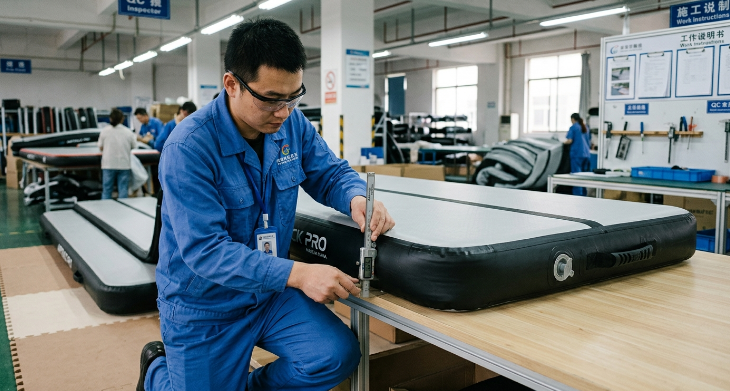
When placing a wholesale order for premium items like a 10ft x 10ft inflatable wrestling training mat with electric pump, you cannot leave thickness to chance. You must proactively enforce it through your purchasing documentation.
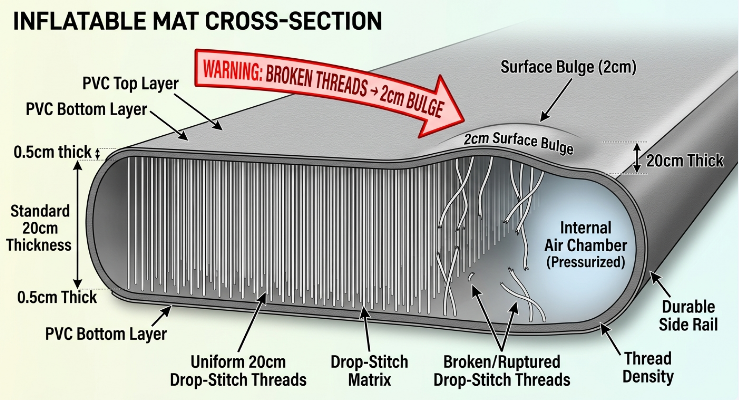
Navigating Chinese manufacturing standards requires understanding the difference between normal material behavior and outright defects. Because DWF relies on thousands of internal polyester threads, a microscopic variance is physically inevitable, but it must be controlled.
| Variation Level | Measurement (Deviation) | Status | Cause |
|---|---|---|---|
| Ideal / Premium | ± 0 to 3mm | Pass | High-quality woven DWF; excellent thread tension and automated cutting. |
| Standard Acceptable | ± 4 to 5mm | Pass | Normal material stretch under PSI pressure; typical for commercial linear DWF. |
| Minor Defect | ± 6 to 9mm | Borderline (Fix/Discount) | Uneven PVC stretching or slight temperature warping during high-frequency welding. |
| Major Defect / Failure | ± 10mm (1cm) or more | Reject | Snapped internal drop-stitch threads; structural failure; severe safety hazard. |
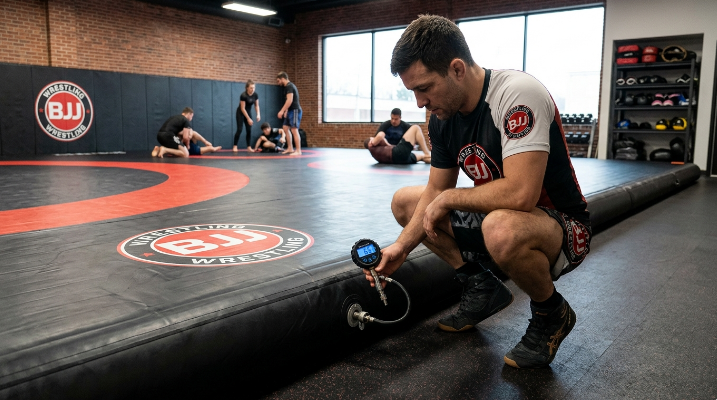
The answer depends entirely on how the difference presents itself: Uniform Variance vs. Localized Variance.
1. What is the maximum acceptable thickness tolerance for professional-grade inflatable wrestling mats?
2. A localized "bulge" or "hernia" on an inflatable mat is usually caused by what?
3. How should a third-party inspector measure the thickness of a mat during QC?
Thickness tolerance is a vital indicator of an inflatable wrestling mat's structural integrity and safety. As a B2B importer, you must communicate strict acceptable tolerances (±5mm) to your Chinese suppliers and enforce them through rigorous pre-shipment grid testing. By rejecting mats with localized variations and broken drop-stitch threads, you protect your brand's reputation and ensure the athletes using your gear remain safe from avoidable injuries.
[^1]: QIMA. (2024). Understanding AQL (Acceptable Quality Limit) in Manufacturing. Retrieved from https://www.qima.com/aql-acceptable-quality-limit
[^2]: ASTM International. (2024). ASTM F355 - Standard Test Method for Impact Attenuation of Playing Surface Systems and Materials. Retrieved from https://www.astm.org/f0355-16e01.html


