Open a drop stitch pool carton and you find two pumps that do not do the same job. One is a hand pump with a pressure gauge. The other is sold separately, plugs into a wall, and looks like the more capable tool. Buyers assume the electric one replaces the hand pump. It does not, and that assumption is behind a lot of slow setups and a fair number of angry reviews.
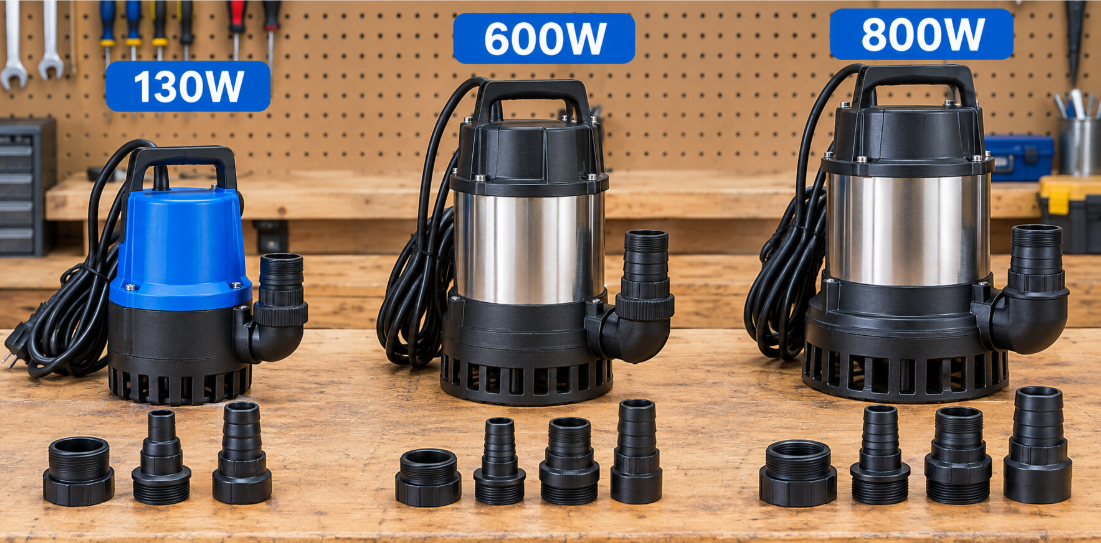
The three electric pumps in the AfterSea range are rated 130W, 600W and 800W. Read the numbers in the right order and the choice is simple. Read them in the wrong order, which usually means starting with watts, and you can pay more for a pump that fills a pool slower.
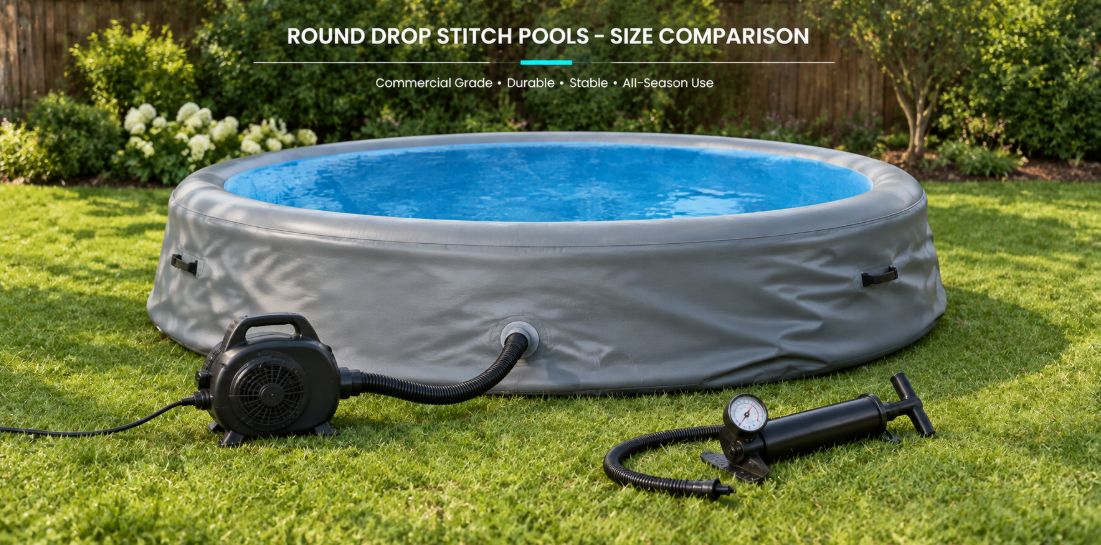
If you want the shortest possible version: for pools, the 130W plus the hand pump you already own is the fastest and cheapest combination. The 600W and 800W differ from each other by half a PSI you cannot use on a pool, and by two nozzles you can.
A drop stitch wall only carries load when the threads inside it are tensioned, and the threads only tension when the air pressure is high enough. Most drop stitch pools run between 8 and 12 PSI, with 10 PSI as the common working pressure for recreational and light commercial units. That figure is covered in more detail in our guide to how the drop stitch core holds 10 PSI.
Now look at what the three pumps can produce.
| Pump | Motor | Maximum pressure | Shortfall against a 10 PSI pool |
|---|---|---|---|
| AEP-AC130W | 130W | 0.58 PSI (4,000 Pa) | 9.4 PSI |
| AEP-AC600W | 600W | 2.5 PSI (17,000 Pa) | 7.5 PSI |
| AEP-AC800W | 800W | 3.0 PSI (20,000 Pa) | 7.0 PSI |
The strongest pump in the range reaches 30% of the pressure a drop stitch pool needs. That is the whole argument in one line. None of these three can finish the job, and no amount of extra watts changes it, because the limit is the pump design rather than the motor.
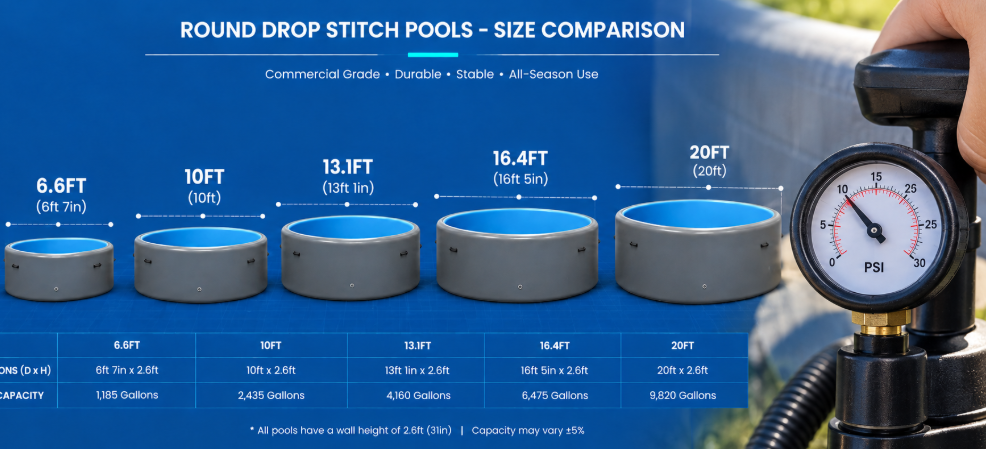
This is also the reason the carton contains a hand pump with a gauge instead of an electric one. A dual-action hand pump with a small bore can reach 15 PSI or more. It is slow, it is tiring, and it is the only thing in the box that can close the last 7 PSI.
Buyers who have never owned a drop stitch pool read the hand pump as a cost-cutting move. It is the opposite. The gauge on that pump is the instrument that decides whether the pool performs.
Underinflate by 2 PSI and the floor feels spongy, the wall bows when someone leans on it, and the seam at the wall base works harder than it should. Overinflate and you put unnecessary load on the same seam. The gauge lets you stop at the number. An electric pump without a gauge cannot tell you where you are.
If you sell these pools, print the two-stage method on the carton or in the manual. A customer who expects the electric pump to finish the job will conclude the pump is broken, and that complaint costs more to handle than the pump is worth.
Here is where most buyers go wrong. The assumption is that 800W moves more air than 130W. On this range, the published figures say the opposite, by a factor of four.
| Pump | Published airflow | In CFM | Type |
|---|---|---|---|
| 130W | 400 L/min | about 14 | Blower: high flow, low pressure |
| 600W | 3 CFM class (see note) | about 3 | Compressor: low flow, higher pressure |
| 800W | 3.5 CFM (99 L/min) | 3.5 | Compressor: low flow, higher pressure |
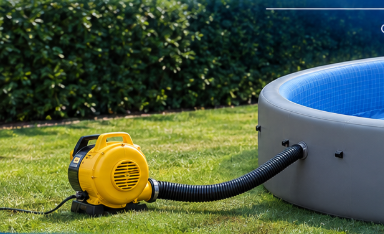
The 130W is a blower. A wide impeller pushes a large volume of air through a big outlet, and the moment the pressure climbs past about half a PSI the flow collapses. The 600W and 800W are small-bore compressors. They move far less air but keep pushing when the pressure rises.
The practical result: the 130W stands up a 6 m pool in a fraction of the time the 800W takes, and the 800W can push a mattress or a bounce house to a pressure the 130W never reaches. Both are correct tools for different jobs. Neither is a better version of the other.
| AEP-AC130W | AEP-AC600W | AEP-AC800W | |
|---|---|---|---|
| Motor | 130W | 600W | 800W |
| Max pressure | 0.58 PSI | 2.5 PSI | 3.0 PSI |
| Airflow | 400 L/min | 3 CFM class | 3.5 CFM |
| Voltage | 110V AC | 110V AC | 110V AC |
| Power cord | 1.6 m / 5.3 ft | 1.6 m / 5.3 ft | 1.6 m / 5.25 ft |
| Noise | Quiet, not rated | 85 dB or less | 85 dB or less |
| Inflation and deflation | Yes | Yes | Yes |
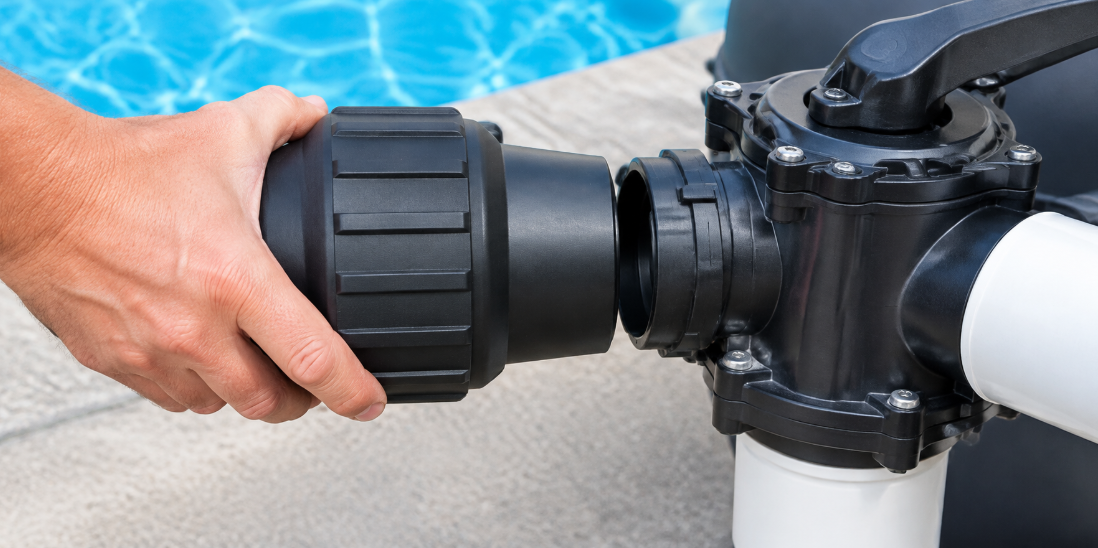
| Nozzles supplied | 3 (7.3 mm small, 17.4 mm medium, large) | 4 (small, medium, large, XL) | 2 (large, XL) |
| Soft tube in box | No | Yes | Yes |
| Overheat protection | Yes, with duty limits printed on the unit | Not stated | Not stated |
| Safety mark | ETL | Not stated | Not stated |
| Auto shutoff at pressure | No | Yes | Yes |
| Warranty | Not stated on page | 12 months | 12 months |
Three differences matter more than the wattage.
Nozzle count. The 800W ships with two nozzles, both large. That is fine for a pool valve and useless for a swim ring. The 600W covers four sizes, which makes it the better single pump for a shop that sells pools, floats and mattresses from the same shelf.
The safety mark. The 130W carries an ETL certificate, which matters if you list on US or Canadian marketplaces that ask for a recognised mark. The 600W and 800W pages do not state one. Ask for the certificate file before you commit to a container, not after customs asks.
The duty limit. The 130W has a printed limit: five minutes on the small nozzle, ten minutes on the medium or large nozzle, then five minutes of rest to avoid overheating. That limit is the single most useful piece of information on any of these pages, and it is the one buyers ignore.
Fill time splits into two parts that behave nothing alike. The volume stage takes minutes. The pressure stage takes tens of minutes. Buyers plan for the first and are surprised by the second.
To calculate the volume stage, you need the air inside the walls and floor, not the water capacity. For the AfterSea round range with a 10 cm core wall:
| Pool | Air volume | 130W at 400 L/min | 800W at 3.5 CFM | Hand pump to 10 PSI |
|---|---|---|---|---|
| 2 m / 6.6 ft | 732 L | 1.8 min | 7.4 min | 10 to 15 min |
| 3 m / 10 ft | 1,527 L | 3.8 min | 15 min | 20 to 28 min |
| 4 m / 13 ft | 2,604 L | 6.5 min | 26 min | 35 to 45 min |
| 5 m / 16 ft | 3,811 L | 9.5 min | 39 min | 50 to 65 min |
| 6 m / 20 ft | 5,422 L | 13.6 min | 55 min | 70 to 90 min |
The electric pump times assume free-flow airflow and will run longer in practice as back pressure builds. The hand pump times assume a dual-action pump moving 1.2 to 1.5 litres per stroke at 30 to 40 strokes a minute, lifting the pool from about 1 PSI to 10 PSI. Treat both as planning figures and clock your own pump once.
Two things shift the numbers. A 15 cm core instead of 10 cm adds roughly 45% more air, so a 4 m pool jumps from 2,604 L to about 3,790 L. Cold weather slows everything down, because PVC stiffens and the walls resist opening.
On a 4 m pool the volume stage is 6.5 minutes and the pressure stage is closer to 40. That ratio is why the choice of electric pump matters less than most buyers expect, and why the hand pump matters more.
The 130W fills a 6 m pool in 13.6 minutes of running at free flow. Its printed limit is 10 minutes on the large nozzle. Those two numbers do not fit together, and that is not a fault, it is an instruction.
Run it as two blocks: 10 minutes on, 5 minutes off, then finish. The motor has a heat path that needs the pause, and the pump is designed with an overheat cutout rather than a bigger housing. Ignore the pause on a hot day in a closed garage and the cutout will stop the pump for you, usually at the least convenient moment.
The 600W and 800W pages do not publish a duty cycle. At 55 minutes to fill a 6 m pool, the 800W is running continuously for an hour, which is a long time for any AC motor without a stated rating. If you plan to use one that way, ask the factory for the rated continuous run time before you buy.
This is the sequence that gets a pool to pressure with the least total effort. It works for every size from 2 m to 6 m.
Step seven is the one people skip. A pool that reads 8 PSI at lunchtime and 6.5 PSI at dinner has not leaked. The drop stitch layer has stretched into its final shape. Top it up once, and the next morning the reading should hold.
If it keeps dropping after the first day, the leak is real. Our guide to finding and patching a drop stitch pool leak covers the pressure decay test and the valve fix that solves most cases.
| Use case | Buy this | Why |
|---|---|---|
| One pool at home, one or two setups a season | 130W plus the hand pump in the box | Fastest bulk fill, lowest cost, hand pump closes the pressure gap |
| Rental fleet, several setups a week | One 130W per crew plus one high pressure pump shared | Volume is the bottleneck on site, pressure can be done at the depot |
| Retailer doing pre-delivery checks | 130W plus a gauge, in a fixed bay | You need to stand a pool up and confirm it holds, not pressurise it to 10 PSI |
| Pools plus mattresses, boats, floats | 600W | 2.5 PSI handles the other goods, four nozzles cover more valve sizes |
| Bounce houses, arches, large rafts | 800W | 3 PSI and the highest airflow of the two compressors |
| 5 m and 6 m pools, inflated weekly | None of the three is ideal | You want a barrel pump rated to 15 or 20 PSI for stage two, then the gauge |
That last row is worth saying plainly. If you inflate large pools often, the tool that saves the most time is a high pressure barrel pump, which is a different device from all three pumps here. It moves air slowly and pushes hard, which is exactly what stage two needs. The 130W still earns its place for stage one, because no high pressure pump fills an empty shell as fast.
All three pumps are 110V AC with a 1.6 m cord. That is a North American product, full stop.
If you sell into the EU, UK, Australia or the Gulf, a 110V pump is not a product you can list. You need a 220 to 240V version, the right plug, and the CE or GS documentation that goes with it. Ask for the voltage variant in the quotation, not after the container lands, because the motor and the plug are both changes.
The same applies to the pool itself if it ships with a pump in the kit. Check the kit's voltage against the destination market before you approve the artwork on the carton, since the box usually prints the voltage.
| Ask this | What the answer tells you |
|---|---|
| What is the airflow at free flow, and at rated pressure with the largest nozzle? | Gives you a real fill time. A single number without a test condition is marketing. |
| What is the rated continuous run time? | Tells you whether an hour on a 6 m pool is inside the design or past it. |
| Which safety marks does the unit carry, and can you send the certificate? | ETL, CE, GS. Marketplaces and customs both ask. A photo of a logo is not a certificate. |
| Which nozzle sizes are in the box, in millimetres? | The 130W small nozzle is 7.3 mm, which will not fit a pool valve. Confirm the large one matches your valve bore. |
| Is a 220 to 240V version available, and at what MOQ? | Decides whether the product can be sold outside North America at all. |
| What is the spare parts position on nozzles and valve caps? | Nozzles are the first thing a rental fleet loses. Loose spares in the carton cut support tickets. |
The maintenance schedule on the 130W is worth copying into your own service documentation, because it is more specific than most: nozzle clearance check every 50 operating hours, filter check every 300 hours or six months, motor bearing lubrication at 1,000 hours. A rental fleet running a pump two hours a day hits the 300 hour filter interval inside a season.
Three things decide whether the pump helps or hurts your business.
Explain the two stages on the packaging. Most pump complaints are not pump faults. They are customers who expected a 3 PSI electric pump to inflate a 10 PSI pool and concluded the unit was defective. A four-line instruction on the carton, or a QR code to a page like this one, removes that whole category.
Stock nozzles, not pumps, as the spare part. Pumps rarely fail in the first season. Nozzles get lost, chewed by dogs, or left in a garden. A bag of spare large nozzles costs very little and prevents a support call that costs far more.
Match the pump to the pool you are selling. Bundling an 800W compressor with a 2 m pool sells the customer a tool that fills it in seven minutes and then cannot finish the job. Bundling the 130W with a gauge and a printed method is the combination that produces a working pool on the first afternoon.
For fleets, the split that works is one 130W per crew for on-site setup, and one high pressure pump at the depot for the final pressurisation and the pre-season pressure check. Pumps are cheap next to a wasted site visit, and a crew that arrives with the wrong pump loses an hour of billable time.
If you run rentals, the pump is also a between-jobs item. Our guide to pool rental business equipment covers the full turnaround routine, and the winter storage procedure explains why the deflate function on these pumps matters at the end of the season.
To specify pumps against a pool order, start from the DWF drop stitch pool range and the pump and repair kit accessories, where the 130W pump, the 600W pump and the 800W pump are listed with their current specifications.
Not with any of the three pumps here. The 800W reaches 3 PSI and a drop stitch pool needs 8 to 10 PSI to tension its core. You can stand the pool up with an electric pump, but the final pressure has to come from a hand pump or a high pressure barrel pump with a gauge.
It has reached its maximum pressure. A blower rated 0.58 PSI produces almost no flow once the pool is near that pressure, so it sounds like it is running while moving very little air. That is normal behaviour, not a fault. Switch to the hand pump at that point.
For filling the empty shell, no. The 130W is rated 400 L/min against 3.5 CFM for the 800W, and it fills a 6 m pool in about 14 minutes against 55. The 800W wins on pressure, which a pool cannot use beyond the first stage. Buy the 800W for mattresses, boats and bounce houses.
About 45 minutes to 1 hour 45 minutes of total work, depending on the pump. Roughly 14 minutes on a 130W to stand it up, then 70 to 90 minutes of hand pumping to reach 10 PSI. Add a two-hour rest and a top-up if it is the pool's first inflation.
A SUP pump is the right idea, since those are barrel pumps rated to 15 or 20 PSI and they will close the pressure gap faster than a hand pump. A tyre inflator is not, because it delivers very little volume and will take hours. Check the valve fitting either way.
The material is relaxing into its final shape. A drop of 1 to 2 PSI over the first few hours is normal on a first inflation. Top it up to 10 PSI and check again the next morning. A pool that keeps dropping after that has a leak, usually at a valve rather than in the wall.