For distributors, sourcing profitable wholesale inflatable gymnastic mats requires a focus on commercial-grade quality, reliable OEM/ODM partnerships, and streamlined logistics. This guide details how to evaluate manufacturers, ensure product safety and durability, and build a private-label product line that drives recurring B2B revenue.
Table of Content:
The Distributor's Dilemma: Sourcing Volume vs. Ensuring Quality
Defining the Gold Standard: What Makes a Commercial-Grade Wholesale Inflatable Gym Mat
The Sourcing Strategy: Vetting Your Manufacturing Partner for Long-Term Success
The Procurement Process: From Initial RFQ to Container Loading
Building Your Brand: The Power of Private Label and Customization
Ensuring a Profitable Partnership: Logistics, Support, and Long-Term Growth
Conclusion: Transforming Your Supply Chain into a Competitive Advantage
As a distributor, your reputation and profitability are built on a simple but critical foundation: the quality and reliability of the products you bring to market. When it comes to wholesale inflatable gymnastic mats, this principle is tested by a fundamental dilemma. On one hand, you face constant pressure to maintain competitive pricing and secure the volume necessary to meet market demand and fill containers efficiently. The allure of a low factory-gate price is powerful. On the other hand, you carry the ultimate responsibility for what arrives at your clients' doors. A container load of subpar wholesale inflatable gym mats—prone to leaks, seam failures, and rapid wear—doesn't just result in a one-time loss. It triggers a cascade of operational nightmares: costly returns, damaging warranty claims, frustrated end-users, and long-term erosion of your hard-earned brand equity. I have seen distributors get trapped in a cycle of constantly switching suppliers, chasing a lower price that ultimately costs them more. The true challenge, therefore, is not just to source, but to source strategically from a partner who views your success as their own, ensuring that volume never comes at the expense of verifiable quality.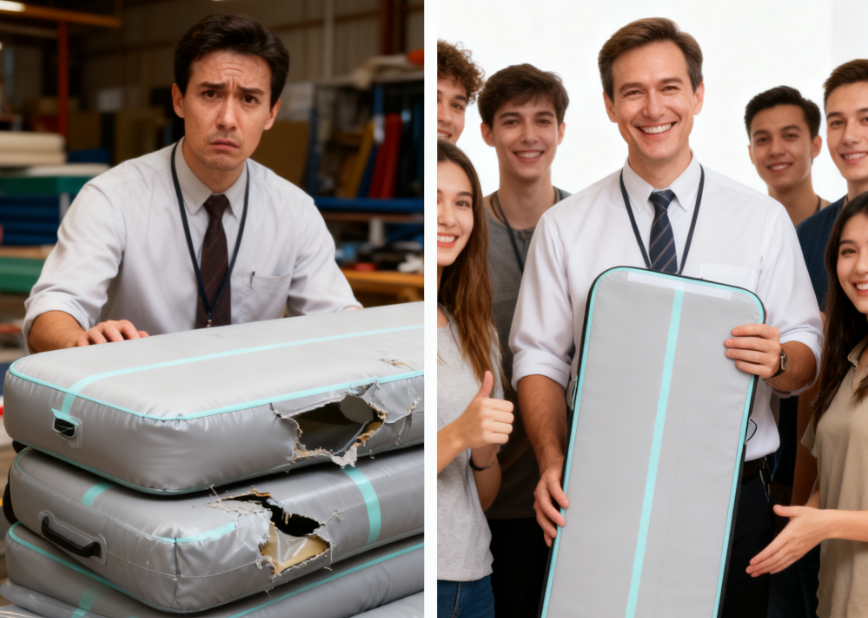
To navigate the sourcing dilemma successfully, you need to establish an uncompromising standard for what constitutes a truly commercial-grade product. This isn't about minor preferences; it's about the non-negotiable specifications that determine whether your wholesale inflatable gymnastic mats will be a one-time sale or a product that builds lasting customer loyalty. Let's break down the components that separate professional equipment from disposable consumer goods.
The quality of the PVC tarpaulin is your first line of defense. For wholesale inflatable gym mats destined for commercial use, you must insist on:
Material Thickness: A minimum of 0.55mm, with 0.65mm or higher being the industry benchmark for high-traffic facilities. This directly correlates to puncture and abrasion resistance.
Tensile Strength: The material must have high tensile and tear strength, measured in Newton, to withstand the repeated impact of tumbling and landings without stretching or ripping.
Low-Temperature Performance: The PVC formulation should remain flexible in cooler environments to prevent cracking, a critical factor for unheated gyms or outdoor events.
The seams are the most vulnerable point of any inflatable product. High-frequency (HF) welding is the only acceptable standard for commercial wholesale inflatable gymnastic mats. This process fuses the PVC at a molecular level, creating a bond that is as strong as the material itself and is far superior to heat-sealing, which is prone to delamination under stress.
Your due diligence must include verifying independent safety certifications. Look for CE, SGS, or ASTM marks, which validate that the materials are non-toxic and the product has passed specific safety and performance tests. Furthermore, consistency is key. Every mat in your container must perform identically—holding air pressure reliably for 24-48 hours, providing a uniform level of firmness, and offering a consistent surface feel. This reliability is what professional coaches and facility managers pay for, and it's what will protect your brand from complaints and returns.
Understanding these specifications is the first step. The next, and more crucial, step is applying this knowledge to find a manufacturing partner capable of consistently delivering to this standard, order after order.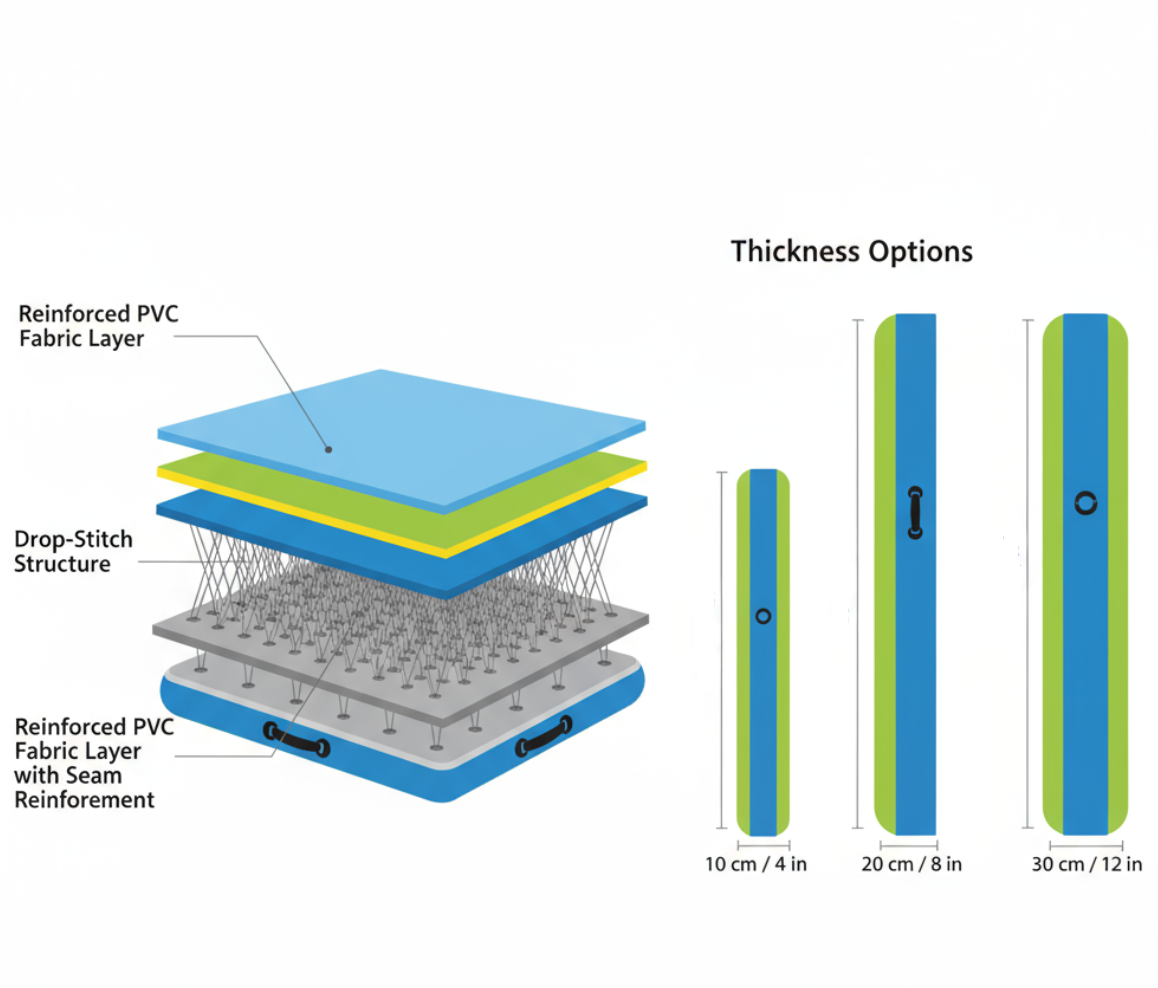
Knowing the technical specifications for quality wholesale inflatable gymnastic mats is one thing; finding a manufacturing partner that can consistently deliver on them across multiple container loads is another. Your choice of partner is the single most critical factor that will determine your long-term profitability and market reputation. This requires a strategic vetting process that looks far beyond the price per unit on a quotation.
A professional manufacturer will be transparent about their operations. During your vetting process, you should:
Request a Virtual Factory Tour: A credible partner will readily provide photos or a live video walkthrough of their production facility, showing their welding equipment, quality control stations, and packing lines.
Evaluate Production Capacity: Ask about their monthly output capacity and lead times. This is crucial to ensure they can scale with your business and handle large, time-sensitive orders without compromising quality.
Review Their Quality Control (QC) Process: Inquire about their in-process and pre-shipment inspection protocols. A manufacturer with a structured QC system will have detailed checklists and be willing to share inspection reports.
As a distributor, your ability to differentiate your offering in the market is paramount. A manufacturer that offers strong OEM (Original Equipment Manufacturing) and ODM (Original Design Manufacturing) services is not just a supplier; they are a strategic partner for your growth. This capability allows you to customize air tracks and other mats with your unique branding, specific sizes, or specialized features, creating a proprietary product line that commands higher margins and fosters customer loyalty. A factory that only sells standard, off-the-shelf products limits your potential.
Finally, seek tangible proof of their experience with international distributors.
Ask for References or Case Studies: A proven manufacturer will have examples of successful, long-term partnerships with other B2B clients.
Analyze Communication and Professionalism: Gauge their responsiveness, their ability to understand your business needs (not just take an order), and the clarity of their documentation. The quality of your communication before the order is the best indicator of the support you will receive after.
Once you have identified a partner that meets these strategic criteria, the focus shifts to the practical execution of your first major order.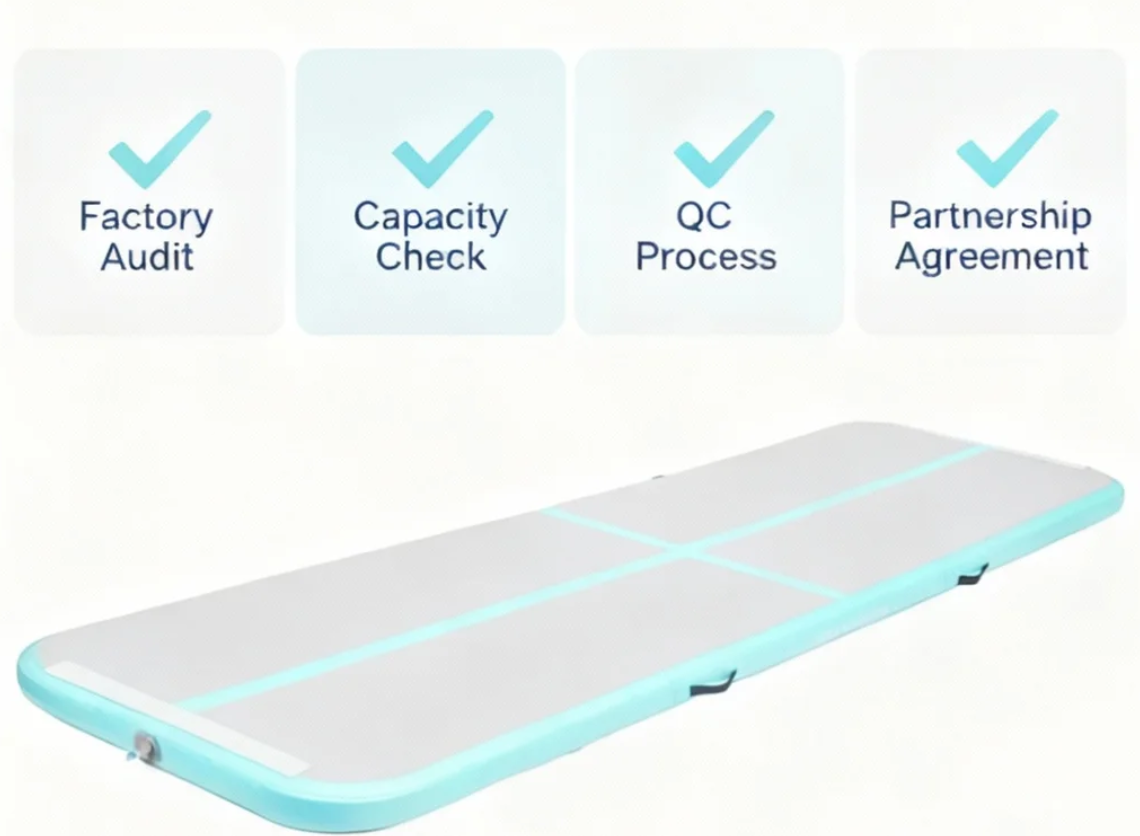
A transparent and well-defined procurement process is the backbone of a successful wholesale partnership. For distributors, predictability and professionalism at every stage are as important as the product itself. Here is a breakdown of the typical journey from your initial inquiry to having a container of wholesale inflatable gym mats ready for your market.
This initial phase sets the foundation for the entire order. A detailed RFQ should go beyond quantity and price. It must specify:
Product Specifications: Reference the required material thickness, weld type, valve style, and safety certifications.
Customization Details: Clearly state your requirements for OEM/ODM, including logo placement, color Pantone codes, and any unique sizing.
Packaging and Labeling: Specify how you want each unit packed (e.g., individual polybags, master carton quantities) and any specific labeling for cartons.
A professional manufacturer will respond with a comprehensive proforma invoice (PI) that details all these elements, leaving no room for ambiguity.
Never proceed to mass production without this critical step. You should:
Order a Pre-Production Sample: Request a sample made to your exact specifications, not a standard catalog item.
Conduct Rigorous Testing: Put the sample through its paces. Test air retention over 48-72 hours, inspect the weld quality under stress, and verify the material's thickness and feel.
Provide Formal Sample Approval: Once satisfied, issue a formal sample approval email or document. This signed approval becomes the quality benchmark for the entire production run.
After depositing payment, mass production begins. A reliable partner will not go silent during this period.
Request Production Updates: A good manufacturer will provide periodic updates, often with photos or videos from the production line.
Consider a Third-Party Inspection: For your first order or large volumes, hiring an independent third-party inspector to conduct an in-process or pre-shipment inspection is a wise investment to verify quality before shipment.
The final stage ensures a smooth handover.
Final QC Check: The manufacturer performs a final quality control check before packing.
Shipping and Logistics: Based on the agreed Incoterms (e.g., FOB), the goods are shipped. You will receive shipping documents, including the Bill of Lading, Commercial Invoice, and Packing List.
Clear Communication: You should receive the container and seal numbers, along with the Estimated Time of Arrival (ETA) at your destination port.
This structured process minimizes risk and ensures that the wholesale inflatable gymnastic mats you receive are exactly as specified and ordered. With a reliable supply chain secured, you can focus on the strategic advantage that truly sets distributors apart: building a powerful brand.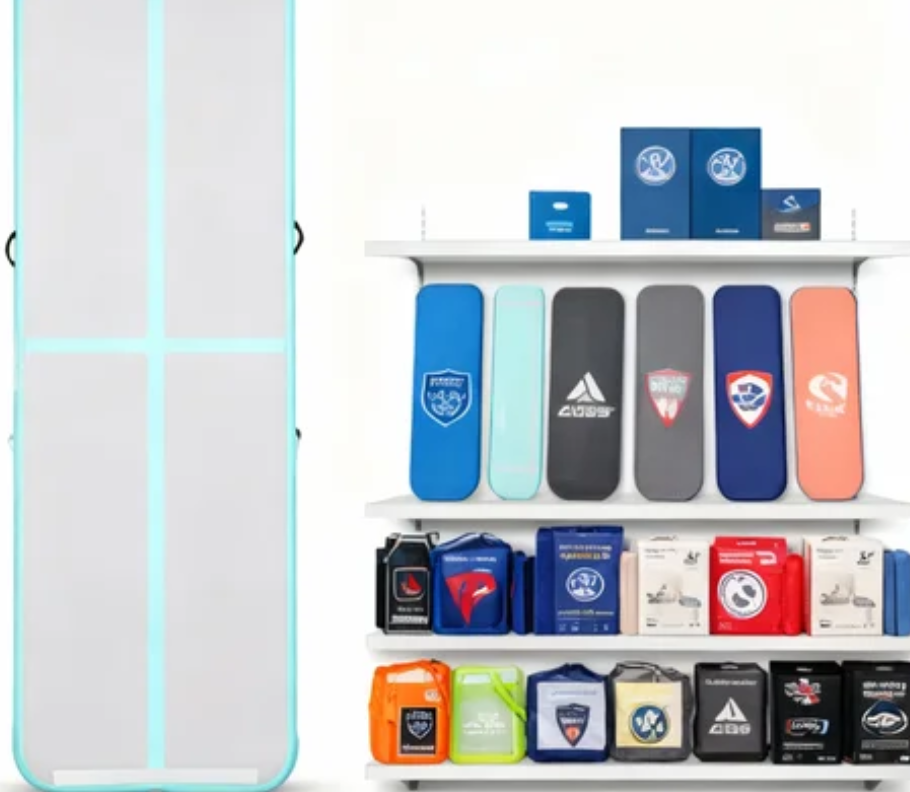
A successful first container order is a significant achievement, but the true measure of a manufacturing partner is their commitment to your growth over the long term. The most valuable partnerships are those that extend beyond the factory gate, providing a foundation of operational reliability and strategic support that allows your distribution business to thrive and expand with confidence.
For a distributor, unpredictable shipping and hidden logistics costs are a direct threat to profitability. A professional partner brings clarity and reliability to the supply chain. They have experience in managing efficient packing to maximize container space, navigating international shipping regulations, and providing all necessary documentation for a smooth customs clearance process. Clear agreements on Incoterms (like FOB or EXW) are essential to avoid unexpected charges. This logistical competence ensures your inventory arrives on time and in budget, allowing you to plan your sales and marketing cycles with precision.
Your reputation is on the line with every product you sell. Therefore, your manufacturer's warranty and support policies are a critical component of your risk management. A credible partner will offer a clear, comprehensive commercial warranty that protects you against manufacturing defects. More importantly, they will have a straightforward process for handling any potential issues, which may include providing replacement units or parts efficiently. This support structure protects your brand and ensures that a rare product issue does not damage your relationship with your end customers.
The ideal partnership is dynamic, not static. As your business grows, your manufacturer should act as a strategic ally, capable of supporting your expansion. This includes the ability to scale production to meet your increasing volume demands and the willingness to collaborate on new product development. By leveraging their R&D capabilities, you can co-create the next generation of wholesale inflatable gym mats, staying ahead of market trends and continually refreshing your product offerings to maintain a competitive edge. This transforms the relationship from a simple buyer-supplier transaction into a collaborative engine for mutual growth.
This comprehensive approach to partnership ensures that your investment in sourcing wholesale inflatable gymnastic mats pays continuous dividends, building a business that is resilient, profitable, and positioned for long-term market leadership.
The journey to sourcing wholesale inflatable gymnastic mats is far more than a simple procurement exercise. For a discerning distributor, it represents a strategic opportunity to build a foundation of quality, reliability, and brand distinction that becomes your ultimate competitive advantage in the marketplace. We have moved beyond viewing this as merely purchasing equipment to recognizing it as forging a partnership that will drive your business growth for years to come.
The blueprint is clear: prioritize commercial-grade specifications, partner with a manufacturer whose capabilities extend to OEM/ODM, and establish a procurement process built on transparency and quality assurance. By doing so, you transform your supply chain from a potential vulnerability into one of your strongest assets. You gain the ability to offer superior products that build customer loyalty, command better margins, and solidify your reputation as a trusted provider of professional-grade equipment.
Stop competing on price alone and start winning with quality and branding. The market rewards distributors who bring value, not just volume.
Ready to build a dominant product line with a reliable manufacturing partner? Contact our B2B team today to discuss your distribution needs, request a catalog, and learn how our OEM expertise can help you customize air tracks and mats for maximum market impact.
Q1: What is the typical MOQ for a container load of wholesale inflatable gymnastic mats?
A: Minimum Order Quantities vary by manufacturer and product specifications, but a typical 20ft container can accommodate approximately 300-400 standard wholesale inflatable gym mats. We work with distributors to establish feasible MOQs that align with your market entry or expansion strategy, often with flexibility for mixed product containers.
Q2: How do you ensure consistent quality across a large production run?
A: Consistency is maintained through a rigorous multi-stage quality control process. This includes in-process checks during cutting and welding, random sampling during production, and a comprehensive pre-shipment inspection against the approved sample. We provide detailed inspection reports and are transparent about our QC protocols to give you complete confidence in every shipment.
Q3: What is the process and lead time for creating our private-label custom inflatable gym mats?
A: The process begins with a consultation to finalize your specifications (design, size, color, branding). We then create technical drawings for your approval, followed by a pre-production sample. The total lead time from sample approval to mass production is typically 25-35 days, plus shipping. We guide you through each step to ensure a smooth and efficient process.
Q4: What support do you provide for new distributors entering the market?
A: We partner with new distributors by providing comprehensive marketing support, including high-quality product images, technical specification sheets, and safety certification documents. We also offer guidance on competitive pricing strategies, packaging options, and can share insights on successful product configurations for different market segments to help you launch and grow your business effectively.


![What Is an Air Track in Gymnastics? [Complete Guide]](http://ueeshop.ly200-cdn.com/u_file/UPBF/UPBF509/2605/13/photo/WhatIsanAirTrackinGymnastics.png)


